
Printful built the modern print on demand game. Fair play to them. But in 2026, it is no longer the obvious pick for a growing store. Base costs crept up. Blanks feel a bit samey. And a lot of us wanted more control over how our brand actually looks in the box.
So we went hunting.
Quick answer: our top pick is PODpartner. It prints your gear in-house, and hands you real branding without a bulk order. Right behind it sit Printify for catalogue size, Gelato for worldwide reach, Tapstitch for premium streetwear, CustomCat for fast US dispatch, and Gooten for stores scaling into serious volume.
Here at DropTweaks we run stores for a living. We have sold on all six of these platforms with our own money, tested the blanks, ordered samples, and watched how each one ships to real customers. This is not a list scraped off other blogs. It is what we would build on tomorrow.
Why So Many Sellers Are Ditching Printful In 2026
Printful is not bad. Far from it. The problem is that it stopped being special.
Margins tell the story. When base costs rise, every sale shaves a little more off your profit. Multiply that across hundreds of orders and it stings. A lean dropshipping business lives on those margins, so even small cost gaps push people to look around.
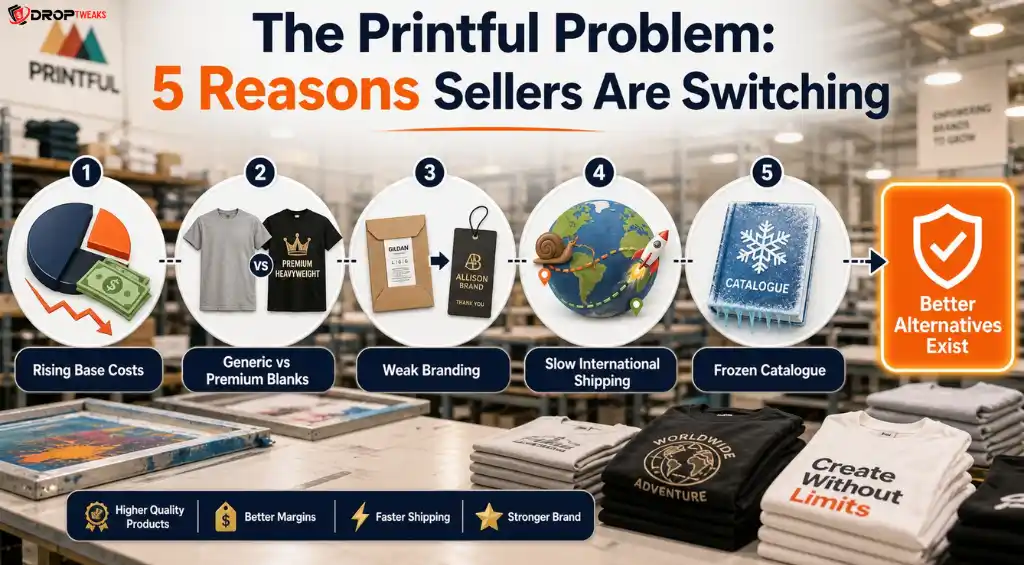
Then there is the blank itself. Standard weight tees look fine, yet they rarely feel like a brand. Buyers in 2026 can spot a generic garment from the product photo alone. Premium heavyweight blanks now sell for more, and shoppers happily pay it.
Branding is the third crack. Real growth comes from repeat buyers, and repeat buyers remember packaging. Custom neck labels, hang tags, branded mailers, all of it turns a random order into your label. Sellers want that baked in, not bolted on.
Add slow lanes on some international routes and a catalogue that feels frozen, and the reason for this hunt becomes obvious. A strong Printful alternative should fix at least one of these pain points without creating three new ones.
How DropTweaks Put These Printful Alternatives To The Test
We judged each platform the way an actual store owner would, not a spec sheet reader.
First, we looked at production quality. Who owns the print, how the ink sits on the fabric, and whether two orders of the same design come out matching. Consistency keeps refund requests low.
Next came the branded dropshipping angle. Neck labels, packaging, inserts, and how much of it you can add per order with no bulk buy. Branding drives loyalty, so this carried real weight.
Speed mattered too. We tracked how fast orders left the door and how far they had to travel. Fast dispatch plus a nearby print hub equals happy customers and fewer “where is my order” messages.
We also weighed catalogue depth, store integrations, and how painless the whole order fulfilment flow felt day to day. A platform can look great and still annoy you at 11pm during a launch.
Every figure below comes straight from each official site, checked this month for 2026. No guesswork, no recycled 2023 stats. Where a platform shines, we say so. Where it stumbles, we say that too. That honesty is why DropTweaks readers keep coming back. 🙌
Top 6 Printful Alternatives: Quick Comparison
Here is the short version before we break each one down. Skim it, then dig into whichever fits your store.
| Platform | Production model | Catalogue |
|---|---|---|
| PODpartner | Vertically integrated, owns its factory | Premium apparel |
| Printify | Marketplace network, 90+ providers | 100+ premium blanks |
| Gelato | Local production network, 32 countries | 1,300+ products |
| Tapstitch | Cut-and-sew, fashion first | Broad, brand-led |
| CustomCat | In-house single facility | 525+ products |
| Gooten | Managed routing via OrderMesh | 100s of products |
Now the good stuff.
1. PODpartner: Best Printful Alternative for Building a Clothing Brand
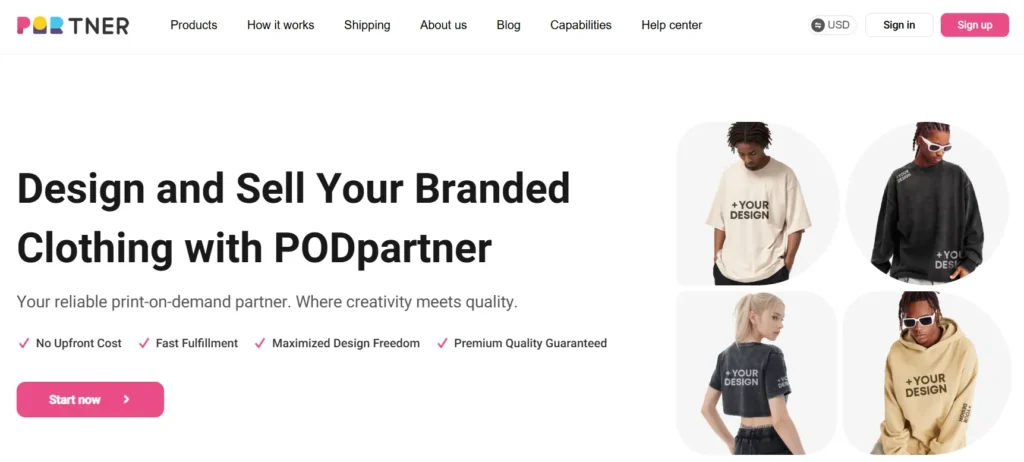
PODpartner grew from an apparel manufacturing business that began in 2013, while its print-on-demand service was established in 2019. Garment sourcing, production, customisation, quality checks, packing, and fulfilment stay within one operation.
That setup gives store owners tighter control over product consistency and branding than a supplier network built around outside providers.
Instead of filling a catalogue with mugs and generic gift items, PODpartner stays focused on apparel. Current range covers T-shirts, long sleeves, hoodies, sweatshirts, tank tops, jackets, shorts, and pants for men and women, including boxy, oversized, washed, distressed, and other streetwear-led styles.
That focus is why it ranks first here. PODpartner suits sellers who want a recognisable clothing label, not a mixed-product merch shop.
Key features
Pros
- Stronger brand presentation than a standard print-on-demand catalogue.
- Apparel focus makes product selection easier for fashion and streetwear stores.
- In-house workflow supports more consistent garments, branding, and fulfilment.
- Low-risk setup works for samples, small drops, and growing stores.
Cons
- Apparel-only range will not suit stores selling mugs, posters, or home décor.
- Orders ship internationally from China, so delivery speed depends on destination and shipping method.
- Native integration list is smaller than broad marketplace-style platforms.
Our verdict: PODpartner is our best Printful alternative for anyone building a clothing-first brand. Premium apparel, streetwear-friendly fits, branded packaging, personalised products, fast in-house fulfilment, and no minimum order solve many pain points sellers face with generic POD suppliers. Printful remains stronger for a wider product mix and local fulfilment coverage, but PODpartner offers a sharper fit for branded apparel.
2. Printify: The Widest Print On Demand Catalogue For Multi-Niche Stores
Founded in 2015 in Riga, Latvia, Printify never owned a single printer. Instead it built a marketplace. You get access to 90+ print providers spread across 140+ fulfilment centres, with more than 10 million merchants already on board. That network is the whole point.
Catalogue size is the headline. Over 2,000 products sit ready to customise, from tees and hoodies to mugs, home goods, and wall art. For a store testing many niches at once, that breadth is hard to beat.
Key features
Pros
- The broadest product catalogue of any platform here.
- More store and marketplace integrations than anyone on this list.
- Provider choice lets you shop around for price and speed.
- Massive proven user base, so bugs get spotted and fixed fast.
Cons
- Quality shifts between providers, so sample testing is not optional.
- A single order split across two providers means two shipping charges.
- Branding options feel lighter than a dedicated apparel maker.
Our verdict: for a store that sells across many niches and wants maximum flexibility, Printify earns its spot. Treat provider choice as a skill, order samples before you scale, and it becomes a reliable engine for a broad catalogue.
3. Gelato: A Local Production Network Built For Worldwide Selling
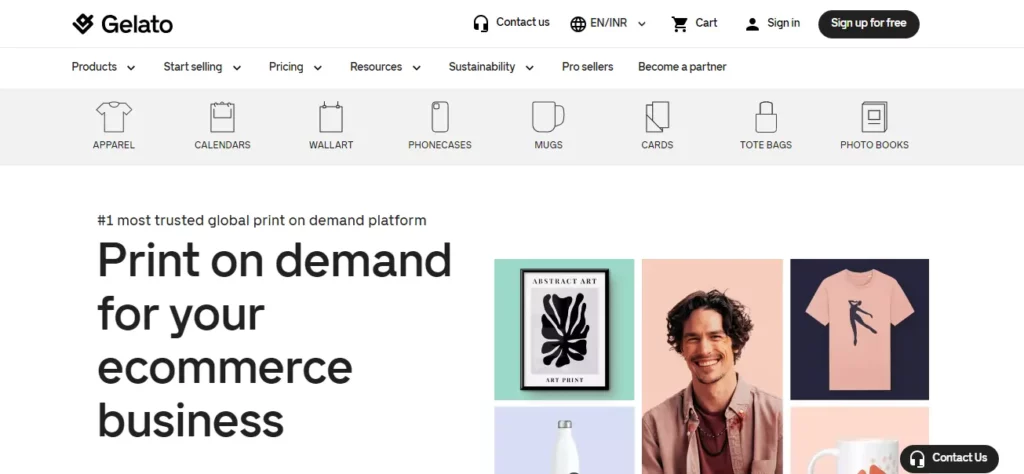
Started back in 2007 in Oslo, Norway, Gelato took a stubborn route. Rather than one mega-factory, it built a local production network of 140+ hubs across 32 countries. When an order lands, a smart routing engine sends it to the nearest hub. The result is short delivery legs and a smaller carbon footprint. Gelato reports that roughly 87% of orders are made in the same country they are delivered to.
For a store shipping to buyers in many regions, that closeness pays off fast.
Key features
Pros
- Fastest option for cross-border and multi-region stores.
- Lower shipping cost and emissions thanks to nearby printing.
- Easy to scale globally without extra ops headaches.
- Wall art range is a standout for home decor niches.
Cons
- Base cost is not always the cheapest on a given item.
- Apparel catalogue runs narrower than Printify's.
- Cross-region items slow down when a local hub lacks stock.
Our verdict: sell to buyers outside your own country, or lean into posters and home decor, and Gelato quietly becomes the smartest Printful alternative you can pick. The local printing model turns global shipping from a weakness into a selling point.
4. Tapstitch: The Fashion-First Choice For Premium Streetwear Brands
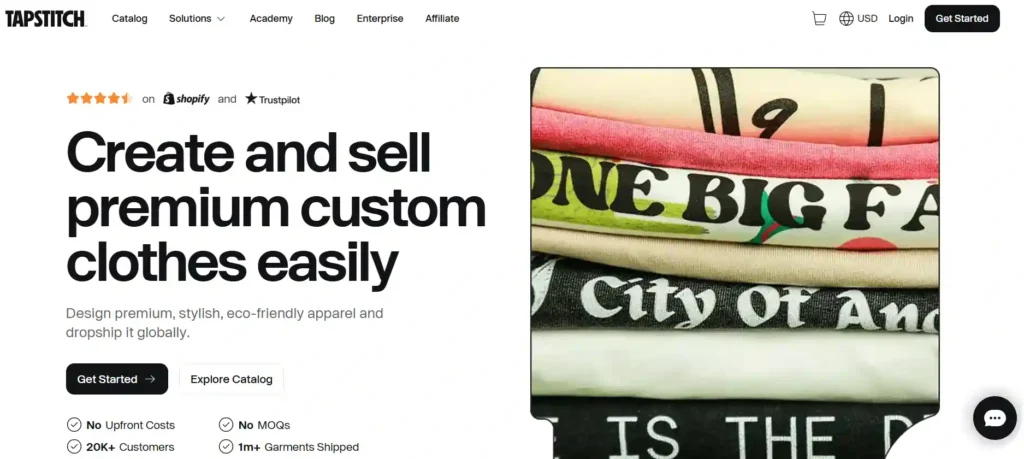
Tapstitch is the newcomer that acts like a veteran.
Launched in 2024 by Joe Zhou out of Los Angeles, Tapstitch skipped generic merch entirely. It focuses on premium quality apparel built the fashion way, with cut-and-sew production and heavyweight blanks.
Backing followed the vision, with around $24.8M in Series A funding from Forerunner Ventures. Momentum is real too: 24,000+ creators and over a million garments shipped already.
If PODpartner is the all-round brand builder, Tapstitch is the streetwear specialist.
Key features
Pros
- Boutique-grade fabric that supports higher price tags.
- Solid US fulfilment for fast domestic delivery.
- Large print areas and fashion finishes rivals rarely offer.
Cons
- Apparel only, with no home goods or accessories.
- International shipping runs slower than the US lane.
- A younger catalogue, and setup feels a touch deeper for first-timers.
Our verdict: for anyone selling a premium hoodie with a real brand feel, Tapstitch delivers the fabric and finishes to pull it off without holding stock. For streetwear and fashion sellers, it is one of the sharpest Printful alternatives around.
5. CustomCat: Fast US Fulfilment Powered By DIGISOFT Printing
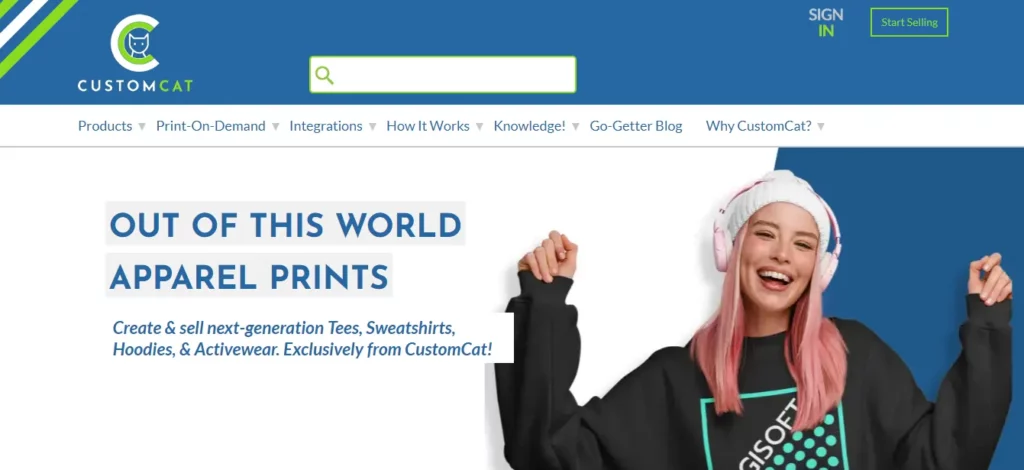
Operating from a single facility in Detroit, Michigan, CustomCat has 20+ years in print on demand fulfilment, making it one of the true pioneers. More than 50,000 businesses have used it, and it ships over 40,000 items a day. Everything is made and shipped from the USA, which suits a domestic-focused store nicely.
The star of the show is DIGISOFT, its proprietary print process.
Key features
Pros
- Quick US dispatch keeps domestic buyers happy.
- DIGISOFT prints stay bold and soft wash after wash.
- Veteran reliability, with a support line you can actually call.
Cons
- US-only, so no EU hub for European buyers.
- Lighter custom packaging than dedicated brand-focused makers.
- Design tooling is basic next to the flashier platforms.
Our verdict: for a US-first store that wants durable prints out the door quickly, CustomCat is a dependable Printful alternative with a genuine print edge. The DIGISOFT durability alone wins repeat customers, and the phone support is a comfort during a busy launch.
6. Gooten: A Managed Fulfilment Network For Stores Scaling Up
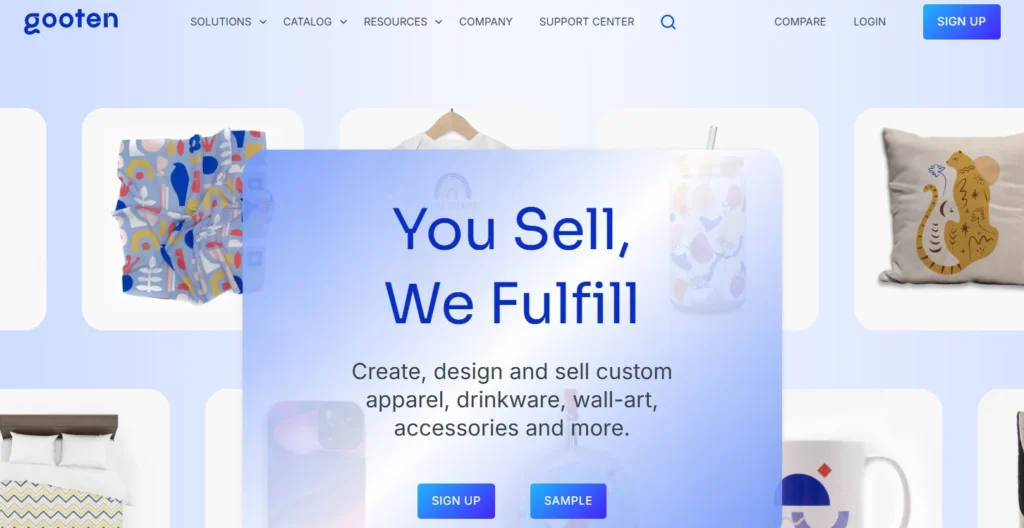
Gooten is the pick for sellers who have outgrown “just get it printed” and now need real operations muscle.
Built over a decade as a managed routing platform, Gooten now sits inside OrderMesh, its cloud-native order system, backed by parent company Taylor Corporation. The Gooten Fulfilment Network spans 250+ production locations and 450+ products, all with a minimum order of one.
A smart routing engine sends each order to the best partner by location and availability, with 70%+ US production and 99% of orders made and shipped within region.
This is infrastructure, not a hobby tool.
Key features
Pros
- Made for high-volume and scaling stores, not fragile at load.
- One unified invoice simplifies messy multi-partner accounting.
- Wide SKU network with strong US routing.
Cons
- Quality can shift across different print partners.
- Branding on parcels is limited for smaller sellers.
- The platform is mid-transition to OrderMesh, and shipping feedback runs mixed.
Our verdict: a first store does not need Gooten. A store pushing serious daily volume very much might. The routing engine and single-invoice setup earn their keep once order counts climb, which makes it a smart Printful alternative for the scaling stage.
How To Pick The Right Printful Alternative For Your Store
Six good options, one store. So how do you choose without overthinking it?
Start with your product. Selling apparel and chasing a real label? PODpartner or Tapstitch give you the fabric and branding to charge more. Selling mugs, posters, and mixed niches? Printify's catalogue depth wins. Home decor and wall art? Gelato leads there.
Then look at where your buyers live. A mostly US audience loves CustomCat's quick domestic dispatch. A worldwide audience is happier with Gelato's nearby printing. A store crossing into heavy volume leans on Gooten's routing network.
Branding is your next filter. If repeat buyers matter, and they should, a maker with strong per-order white label fulfilment like PODpartner keeps your name on every parcel.
One rule beats all the rest: order a sample first. Always. Feel the blank, check the print, time the delivery. That single test tells you more than any review, ours included.
Switching From Printful Without Breaking Your Store
Moving platforms sounds scary. It really is not, if you go in order.
Keep your Printful store live while you test the new one. Nothing worse than pausing sales for a migration. Run both in parallel until you trust the replacement.
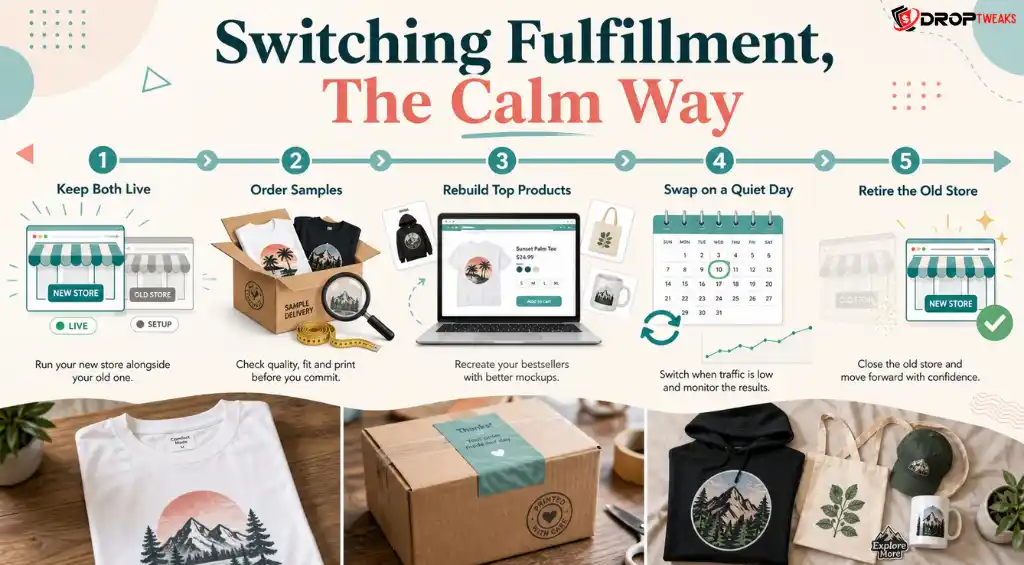
Order matching samples of your best sellers from the new platform. Compare fabric, print placement, and colour against your current gear. Buyers notice a sudden change, so match it or improve it, never downgrade.
Rebuild your top products on the new maker before touching listings. Line up mockups, sync the store, then swap fulfilment on a quiet day, not mid-launch. Watch the first batch of live orders closely.
Finally, retire the old products once the new ones prove themselves. Slow and steady keeps your reviews clean and your customers none the wiser. A calm switch protects the reputation you worked hard to build.
Final Verdict: Our Top Printful Alternative For 2026
After testing all six with our own stores and our own cash, our answer is simple: start with PODpartner.
The vertically integrated model fixes the exact things that push sellers away from Printful. Better blanks, real branding, fast in-house dispatch, and no minimums. For a brand-led apparel store, nothing else here matches that combination.
Round it out based on your goals. Go Printify for the widest catalogue and the most integrations. Pick Gelato for worldwide reach and wall art. Choose Tapstitch for premium streetwear, CustomCat for quick US prints with DIGISOFT durability, and Gooten once your volume gets serious.
Six strong makers, zero bad choices, and plenty of room to build. Order a sample, back your favourite, and go sell something great. We will see you in the comments.